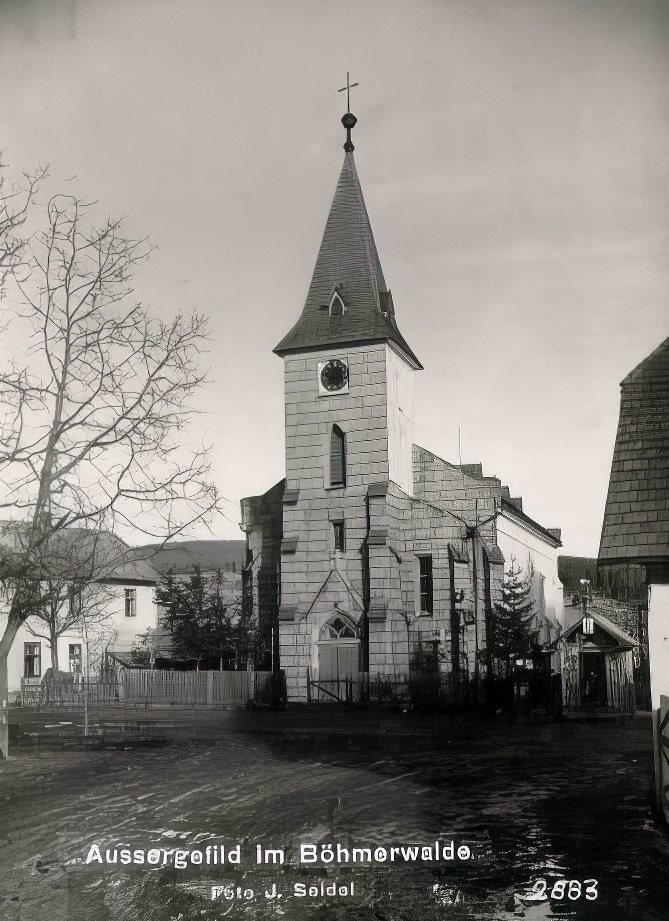
In 1765, the Prague archbishop's consistory approved the request of the faithful from Kvilda and granted permission to build a church with a cemetery. The wooden church, whose walls were covered with shingles, was dedicated to the memory of the Finding of the Body of St. Stephen.
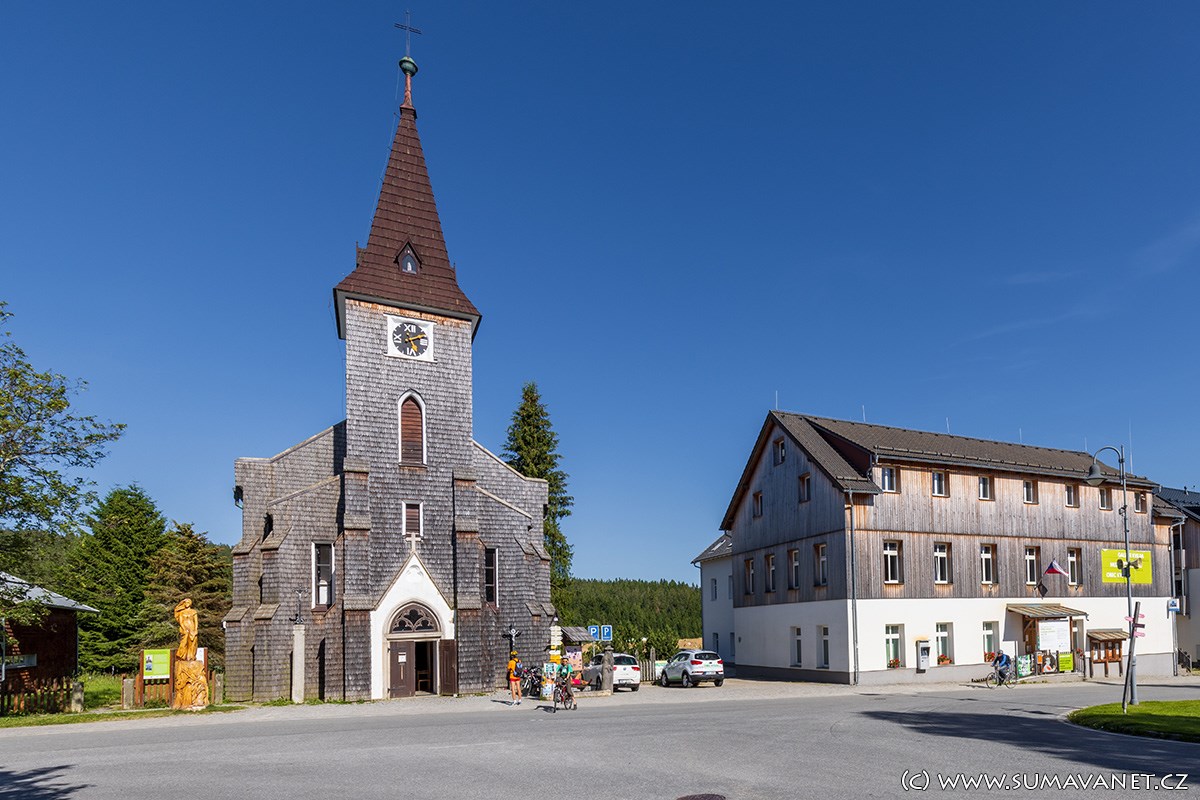
In 1889, a large fire broke out in the center of the village, destroying 18 houses, the newly built school, and the wooden church. In 1892, construction began on a new stone church on the site of the burned one, inspired by the neo-Gothic church in Knížecí Pláně. The new Church of St. Stephen was consecrated in 1894 and became a part of the spiritual life of the people of Kvilda and surrounding upper Šumava villages. Today, it forms a characteristic silhouette of our village. It is one of the few churches that survived not only the war but also the subsequent totalitarian regime, which was not friendly to church monuments.
On Sunday, August 4, 2002, a new bell was hung in the church tower and consecrated by the Bishop of České Budějovice, Msgre. Jiří Paďour. The 174 kg bell was cast by the bell foundry of Marie Tomášková-Dytrychová. Today, the sound of the mountain church's bells rings out across the quiet landscape three times a day – at 8 a.m., noon, and 7 p.m.
Today, masses and occasional sacred music concerts are held in the church. The Church of St. Stephen is a registered cultural monument.
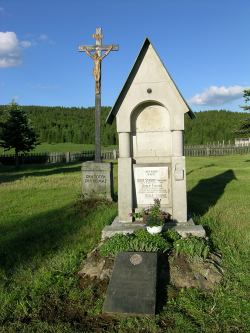
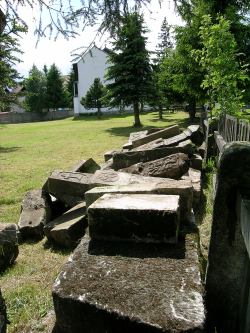
A cemetery was established next to the original church. In 1978, it was insensitively destroyed – metal and cast iron crosses were taken to scrap, and the stone tombstones were transported to the former border zone near Hraběcí Huť. In the spring of 2004, after twenty-eight years, the tombstones were symbolically returned to the Kvilda cemetery.